


Students of the George Washington University (GW) are known for crossing boundaries–intellectually and creatively. Last fall, 15 undergraduate and graduate students merged their scientific and artistic talents in the special topics class, “Food, Flow, and Photography,” where they created science you can see and art you can feel.
With support from GW’s Global Food Institute (GFI), the class explored the intersection of physics, culinary art, and visual storytelling through the lens of photography and fluid dynamics–the study of how liquids and gases flow. Co-taught by Azar Panah, an associate professor at GW’s School of Engineering & Applied Science (GW Engineering), and Meredith Rizzo, an adjunct professor at the Corcoran School of the Arts & Design, the course invited students to experiment, innovate, and capture the hidden beauty of how liquids and gases move.

Throughout the course, students revealed the hidden physics of fluid flows through the art of cooking. They experimented with techniques for visualizing flows in soups, sauces, mocktails, coffee, tea, caramelization, and more during on-campus cooking demonstrations with Chef Jarrod Himes, Executive Chef at GW, with support from the GW Dining Team.
“Chef Himes and his team played a central role throughout the course, generously supporting the demonstrations and welcoming students into his kitchen for hands-on cooking sessions. We are very thankful for his support,” said Panah.
In addition to hosting a series of weekly workshops in Spring 2025 to help Panah develop the course, GFI provided the essential cooking equipment for the demonstrations and reimbursed the cost of ingredients for each session.
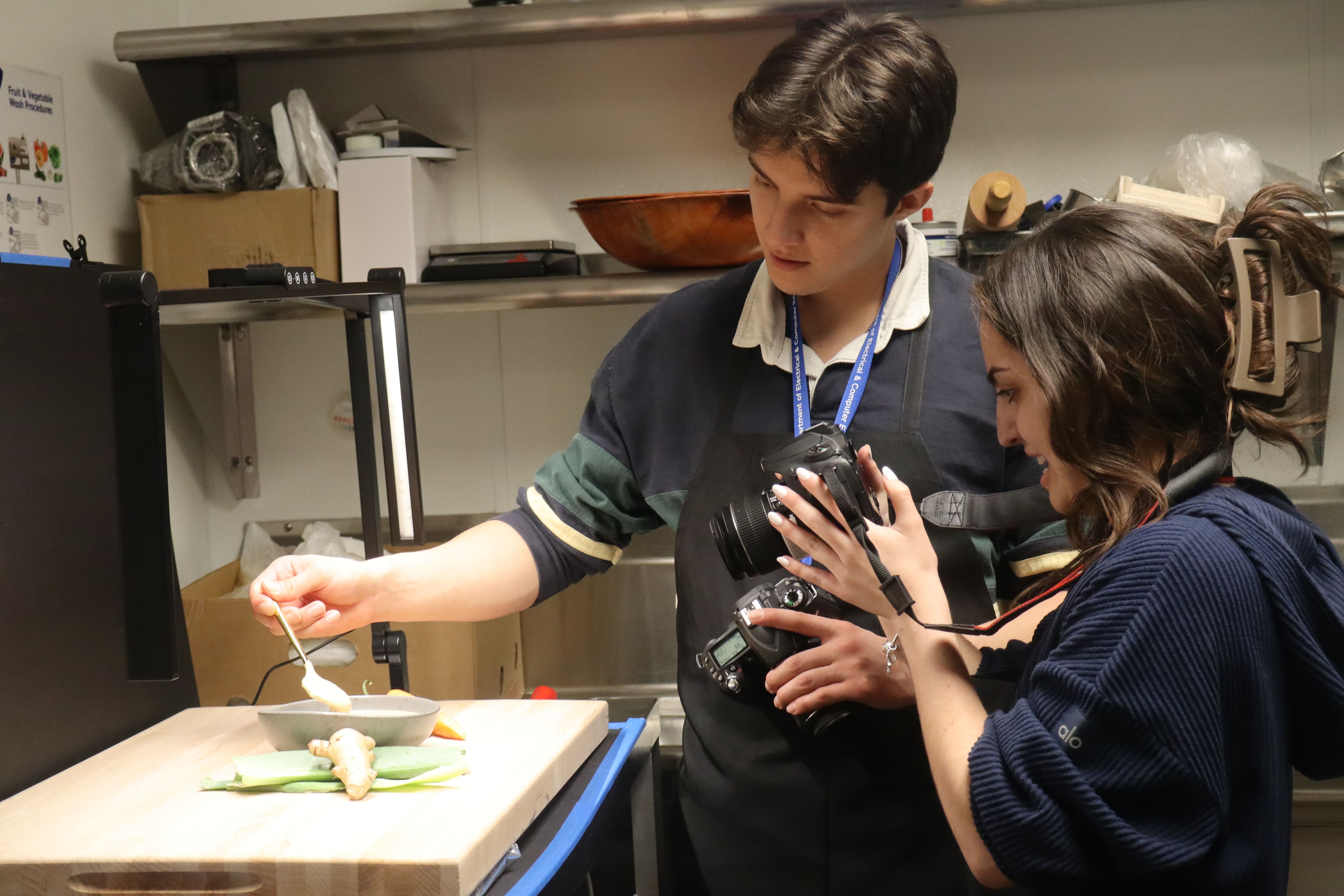
As they explored culinary demonstrations, students also learned to use a professional camera to visually capture these dynamic phenomena.

After weeks of blending science and art, students gathered in the Science & Engineering Hall on December 5 to present their final pieces to the GW community. Claudia S. Rodriguez Chevere, a senior mechanical and aerospace engineering major, is pictured with her piece, “Stuck on Ice: A Sweet Frozen Snapshot”, which showcases a milk chocolate and coconut oil mixture poured over ice. She shared with attendees that the ice acts like a heat sink, solidifying each drip in place, and that changing the fat composition of the mixture affects the speed of this process.

Each student used their unique artistic lens to display such complex scientific concepts. One example is Nora Zhang (right), a senior fine arts major in the Columbian College of the Arts & Sciences (CCAS), who shared her inspiration for photographing the slow collapse of fruit and bread with GW Engineering Professor Caitlin Grady (left), Director of Research and Policy at GFI.
In her poster description, Zhang wrote: “Decay is not a failure of matter, but its continuous movement; moisture migrating through softening skin, spores drifting outward in quiet spirals, sugars breaking apart under the work of invisible lives. What looks still is already in motion. The blooming mold becomes a kind of writing – a reminder that all food carries its own future, and that transformation is the most natural rhythm of life.”


The final presentation provided not only an opportunity for students to share their art with the broader community but also to practice explaining the science behind it. For instance, the pieces above demonstrate two ways to visualize viscosity, which describes a fluid’s resistance to flow.
On the left, Lisa Roberts, a senior fine arts major in CCAS, explains how oil viscosity changes with temperature and the addition of baking soda in a mixture of warm water, vegetable oil, vinegar, and food coloring. Her piece, “The Shape of Escape (Viscosity in Motion)”, shows how small oil droplets form in warm water and attach to carbon dioxide gas released when baking soda is added. These small droplets then rise to the surface, while heavier oil sinks back down.
On the right, Adam Harwood, a second-year graduate student in mechanical and aerospace engineering, describes viscosity in molded candy. His piece, “Removing Surface Imperfections in Molded Candy,” demonstrates how imperfections in a candy mold cause air bubbles near the surface and how to remove them.
“By carefully applying heat to the surface with a blowtorch, the candy’s viscosity decreases, allowing it to flow slowly and fill in imperfections,” Harwood wrote in his poster description.

By seamlessly integrating concepts from various fields, the course gave each student practical skills in visual presentation and scientific communication, equipping them to share science in an engaging way.
“With the GFI and GW Dining team, we would like to grow this into an ongoing initiative, aligning around food sustainability, food security, and the meaningful role food plays in building community at GW. We truly appreciate the support from the Global Food Institute, the Mechanical and Aerospace Engineering Department, the School of Engineering & Applied Science, and the Corcoran School of the Arts & Design,” Panah concluded.